

EIDON Ionic Minerals
Guest: Rick Wagner, MS, CN, Author of Balance Your Terrain
Most of us grew up believing that strong bones start and end with calcium. Yet here in America, where calcium supplements and dairy are everywhere, osteoporosis is on the rise. We find ourselves confused about everything related to great skin, hair, nails, and tissues. Silicon stimulates collagen production, strengthens connective tissue, and helps direct calcium into your bones rather than your joints and arteries. This is an essential element!
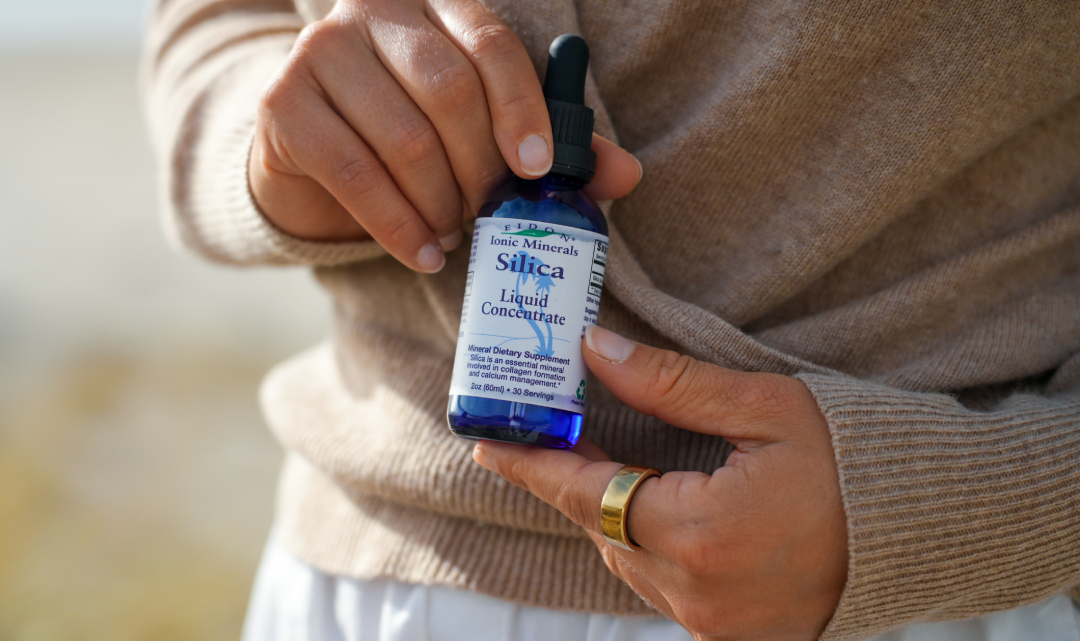
EIDON Ionic Silica – The purest on the planet.
SPECIAL OFFER: SAVE 10%! Visit EIDON.com Use code DLIN10
Look for Balance Your Terrain at the same site!
Balance Your Terrain
In “Balance Your Terrain: A Guide to Optimal Health and Freedom from Dis-ease,” Rick Wagner offers a fresh take on health that’s down-to-earth yet cosmic in scope. He dives into the idea that we’re all connected to the vast universe, highlighting both our shared origins and our unique individuality.
Rick isn’t afraid to challenge mainstream medicine, suggesting that true well-being comes from living in harmony with our bodies’ natural rhythms rather than relying solely on interventions.
Introduction
The AI (adequate intake) of the DRI (dietary reference intake) for calcium ingestion ranges from 210mgs for an infant to 6 months old (what an infant will receive from its mother’s milk) to 1200 mgs per day for people over 51 years of age. A large number of Americans are following this protocol in daily calcium supplementation over and above whatever calcium they may be obtaining in their daily diets. And yet today, Americans exhibit the highest levels of osteoporosis and osteoarthritis among all developed countries. When compared to all other countries, the percentages are even higher. On the other side of the equation, there is no recommended intake level for the element silicon and we get very little silicon in the current SAD (Standard American Diet). The link between these two minerals is significant. Adequate dietary levels of silicon are essential for the support and maintenance of bone and connective tissue. It is the lack of silicon in our diet that is the concern, not the lack of calcium.

Historical Dietary Consumption of Calcium and Silica
100 years ago, modern refrigeration was in its infancy and most Americans did not consume dairy products daily if at all. Dairy was only available on the farm when a farmer had a pregnant cow with no calf to feed. When consumed, milk and other dairy products were taken fresh and raw. Obviously, this lack of supply precluded those consumers who did not have a cow from access to the currently most recognized source of dietary calcium. Interestingly, there are no historical references at the time to calcium deficiency as a result of a lack of access to dairy products. At the same time, calcium supplementation was unheard of and up until the 1980’s, was not a prevalently supplemented mineral. Also, while osteoporosis had been identified as a bone disease in the 1830’s by Jean Georges Lobstein, a French pathologist, it did not become defined as a widespread and growing disease until the 1980’s. Could it be that osteoporosis’s identification as a prevalent and growing disease has been more related to our ability to image bone mineral density than actual fracture rates?
Roles of Silicon in the Body
As with each individual element, metabolic roles vary widely. Silicon has been identified in research by Carslile, Schwartz, Loeper, Kervran, Bergna, Iler, and others as absolutely essential for life playing key roles in:
• Collagen production for healthy hair, skin and nails
• Calcium management
• Bone formation, and
• Connective tissue formation
Silica is absolutely essential, in good supply, for the body to be able to maintain proper collagen levels. Silica is in fact the catalyst for collagen formation and the carrier of calcium into bone. Without it, the body will store ingested calcium wherever it can. Alternative locations include joints, organs, arteries, and soft tissue.
Silica
Two independent researchers in particular have looked extensively at silica in its biological role in mammals and birds-Edith Carlisle and Klaus Schwarz. Most notable in my opinion is the work of Carlisle, performed throughout the 70’s at the UCLA School of Public Health. Her work demonstrated that connective tissues such as aorta, trachea, tendon, bone, skin and its appendages are unusually rich is silica. All the while, blood levels of silica remain quite constant averaging 50ug/dl. Initially, she demonstrated that silicon is involved in an early stage of bone calcification. This was followed by demonstrating the impact of dietary deficiencies of silicon in young chicks.

Origin of All the Misinformation
I believe that we are focusing on calcium rather than silica for several reasons:
1. Calcium is the most obvious element to focus on. It is the most prevalent mineral in our body. It also represents the densest portion of bone. And, in fact, bone does lose some of its calcium content as osteoporosis advances. Though it does not contribute to the creation of the collagen portion of bone structure, only its shape and rigidity. It is the integrity of the collagen matrix of bone that provides for its resiliency. This has somehow been missed by mainstream medicine, nutrition and science, not though because of a lack of available research.

How Did We as a Species Obtain Silica and Vitamin D Before the Industrial Revolution
Historically, 100 to 150 years ago and earlier, silica was much more prevalent in our diets. It was available in our breads primarily from the husks of grains. Technology did not exist prior to the industrial revolution to remove these husks. Consequently, flour included the husks and was also ground using stone grinders. They were usually made of granite, which is a silica rich rock matrix. Additionally, vitamin D was not in short supply as we were an outdoor species. We worked and played outside where we were constantly exposed to UV energy waves providing us with all of our needs of this essential vitamin. We produce vitamin D in our skin when cholesterol is converted to vitamin D via UVA and UVB rays from the sun.